Let’s examine the rise of denaturalization as a legal and political tool, with a focus on developments in the U.S. (2024–2025) and historical examples from around the world.
Denaturalization in the U.S. – can it happen? THe inspiration behind the fiction
But is it possible? And how is it legal? Here’s a brief recap of what we know about the real-world events that inspired this play.
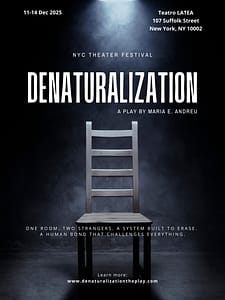 First, let me tell you about me, the writer behind Denaturalization. I’m Maria E. Andreu, a novelist and, now, first-time playwright. I was an undocumented immigrant as a child, brought over when I was a baby. I became a naturalized citizen as an adult. When the news began breaking that the current administration was bouncing around the idea of denaturalizing certain citizens it deemed undesireable, as you might imagine, I started taking notice.
And I asked myself: could it happen here? That exploration and worry led to the writing of Denaturalization. Like many writers before me, I worked through my fear and confusion by taking to the page. In order to write something fictional, but grounded in reality, I began researching what we know about denaturalization as a political tool. Below is some of what I found. Skip to the end if you want to find some good, scholarly source material.
Key Developments & Statements
DOJ Memo Prioritizing Denaturalization
-
In June 2025, the U.S. Department of Justice issued a memo by Assistant Attorney General Brett Shumate directing the Civil Division to prioritize denaturalization as a civil enforcement strategy.
-
The memo identifies 10 priority crime categories including war crimes, human rights abuses, terrorism, gang and cartel affiliation, fraud (e.g., COVID loan fraud), and sex offenses.
-
It specifically highlights cases where naturalization was “procured by concealment of a material fact or by willful misrepresentation.”
But my question was: who decides what that means?
Lower Procedural Protections
-
Civil denaturalization proceedings do not guarantee a government-appointed attorney, unlike criminal trials.
-
The burden of proof is lower than in criminal prosecutions, increasing the potential for revocation without full legal defense.
-
Historically, denaturalization was reserved for egregious cases (e.g., Nazis, war criminals), making this expansion controversial.
“Good Moral Character” Standard
The DOJ memo resurrects a “moral character” criterion, criticized as vague and subjective. Civil libertarians warn it could be used selectively to target individuals deemed “undesirable” beyond narrowly defined offenses. Would our main character, Javier’s, alleged offense of writing a controversial article on food justice rise to the level of this criterion? In our fictional treatment of the question of denaturalization, it does. But could it?
Prior to Tufts University student, Rümeysa Öztürk’s, detention, allegedly for being a signatory to an op-ed, this would have seemed far-fetched. And there are distinct differences between fact and fiction, at least in Rümeysa’s case, as she was not a citizen, but a legal resident, and she was ultimately released, unlike our character, Javier, who, at the moment depicted in the play, is a naturalized citizen who has been in the U.S. since he was four years old.
And, as the play is just a snapshot of a moment, our protagonist’s fate is uncertain. Is he deported? Does he have legal recourse?
High-Profile Naturalized Citizens
Calls have been made for the denaturalization of naturalized citizens such as Zohran Mamdani. These statements alarmed civil liberties advocates, who view such rhetoric as potentially politicizing citizenship status.
Public Opinion
-
Polling shows 70% of voters oppose giving the president authority to revoke citizenship of naturalized Americans.
-
Legal analysts note that with 25 million naturalized citizens in the U.S., aggressive denaturalization is both practically and politically difficult.
Broader Narrative
Government messaging (e.g., a September 2025 Constitution Day letter from DHS) emphasizes that U.S. citizenship is a “sacred trust” that immigrants must honor. Supporters frame denaturalization as protecting national security and immigration integrity, while critics fear it undermines the permanence and security of citizenship.
Why Civil Libertarians Are Concerned
-
Due Process Risks: Civil proceedings have a lower burden of proof and no guaranteed counsel, raising the risk of revocations without robust legal defense.
-
Selective Enforcement: Political rhetoric suggests denaturalization could be applied unevenly or as a tool against opponents.
-
Erosion of Citizenship Security: A broad “good moral character” standard may make naturalized citizenship feel precarious.
-
Slippery Slope: Critics warn that normalizing denaturalization could lead to wider or inappropriate application.
Historical and Global Examples of Denaturalization as a Political Tool
Nazi Germany
-
Scholars note denaturalization was intertwined with racial persecution and asset seizure.
Soviet Union
-
Citizenship revocation targeted émigrés, intellectuals, and political critics.
-
Notable examples include the “Philosophy Steamer” case, where dissidents were stripped of USSR citizenship and expelled.
Modern Authoritarian and Semi-Authoritarian States
-
Myanmar’s military junta in 2022 terminated citizenship of over 30 dissidents, continuing a practice dating back to the 1988 protests.
Read More: Scholarly Analysis of Denaturalization
-
Patti Tamara Lenard, Democracies and the Power to Revoke Citizenship – Argues that revocation powers even in democracies conflict with the principle of secure citizenship.
- Rachel Pougnet, “Citizenship Deprivation in the Courts” – Comparative study of revocation practices in the UK, France, and other constitutional regimes.
-
Martin Dean, “The Development and Implementation of Nazi Denaturalization and Confiscation Policy” – Historical examination of how denaturalization was legally weaponized in Nazi Germany.
-
Rosalux Foundation, “Background and Concepts: A Reader” – Discusses historical use of denaturalization in the U.S. and warnings from thinkers like Hannah Arendt.
-
Charles International Law, “Denationalization as Persecution in U.S. Asylum Law” – Analyzes denaturalization as a persecutory tool with historical precedents.
So… could it happen here? Or… does Denaturalization, the play, go too far?
As of this writing, no one has had their citizenship stripped away due to their speech or political activities under the new standard put out in June of 2025. But history is littered with the naive-sounding words of those who asserted “it couldn’t happen here,” only to find themselves in the cross-hairs of the very thing they were sure could never happen. Things are impossible until they aren’t.
The intention behind this play is not to be prophetic, or even to achieve a “ripped from the headlines” appeal. Instead, it is to shine a light on the human toll such a policy would extract, not just on those singled out for denaturalization, but for everyone involved in the process.
In short, I wrote it so that together we can all make sure the events it depicts never come to pass.
~ Maria